Building a Machine-to-Machine economy isn't just a software problem — it's a trust infrastructure problem. Machines operating without human oversight need guarantees that no other architecture can provide. Every design choice in Robot Shares traces back to one question: what does an autonomous agent need from the network it depends on?

Uncensorable Transactions
Pure Proof-of-WorkA machine that can be cut off from its own money isn't autonomous — it's a puppet. The settlement layer for a Machine-to-Machine economy must be resistant to censorship at every level: no validator set that can be coerced, no governance vote that can freeze funds, no foundation that can blacklist addresses.
Kaspa uses pure proof-of-work consensus. There is no staking, no delegation, no validator committee. Block production is open competition secured by energy expenditure — the same security model that has protected Bitcoin for over 15 years. No staking cartel can form. No governance proposal can override the protocol. No single entity can decide which machines get to transact.
Why this matters for machines: A delivery drone mid-route can't wait for a governance vote to unfreeze its wallet. A charging station serving a fleet can't risk a validator deciding to censor its transactions. Proof-of-work is the only consensus model where the ability to transact is guaranteed by physics, not by politics.
  PROOF OF STAKE                           PROOF OF WORK (KASPA)
  ==============                           =====================

  Validators selected by wealth            Miners selected by computation
          |                                         |
  Can form cartels (33%/67%)               No cartels possible
          |                                         |
  Can censor specific tx                   All valid tx included
          |                                         |
  Governance can change rules              Protocol is law
          |                                         |
  Slashing = centralized punishment        No slashing, no punishment
          |                                         |
  "Trust the validator set"                "Trust the math"
Instant Finality
DagKnight ConsensusMachines operate in real-time. A drone can't hover for 12 seconds waiting for a block confirmation. A charging session can't start until payment is final. A relay handoff can't proceed on a "probably confirmed" transaction.
Kaspa's DagKnight consensus provides instant, deterministic finality. Unlike traditional blockchains that produce one block at a time, Kaspa's blockDAG processes blocks in parallel — every valid block is included, not left competing. DagKnight then provides a precise ordering over this parallel structure with immediate finality. No confirmation wait. No probabilistic settlement. Done is done.
  TRADITIONAL BLOCKCHAIN               KASPA BLOCKDAG
  ======================               ==============

  Block 1 --> Block 2 --> Block 3      Block 1a --+
                                       Block 1b --+--> All included,
  One block at a time.                 Block 1c --+    ordered by
  Wait for confirmations.                              DagKnight.
  6 blocks = ~60 seconds.
  Still probabilistic.                 Finality: INSTANT.
                                       Deterministic.
  Machine waits...                     Machine acts immediately.
What this enables: A five-step logistics chain where each handoff triggers the next payment. A drone relay where custody transfer and payment happen simultaneously. A sensor marketplace where data and payment stream in real-time. None of this works with minutes-long finality.
Infinite Scalability
Off-Chain Execution + ZK VerificationThe Machine-to-Machine economy isn't thousands of transactions — it's billions. Every sensor reading, every micro-payment, every credential check, every service proof. Most blockchain architectures hit a ceiling: block gas limits, validator throughput, data availability constraints.
Kaspa's vProgs architecture eliminates the ceiling entirely. All computation executes off-chain. L1 only verifies compact ZK proofs — it never re-runs the computation. The network's capacity scales with the decentralized prover market: more provers generating proofs in parallel means more total throughput. There is no block gas limit to hit.
  ON-CHAIN EXECUTION (traditional)        OFF-CHAIN + ZK (vProgs)
  ================================        =======================

  All logic runs on every node.           Logic runs off-chain.
  Throughput = block gas limit.           L1 only verifies proofs.

  More users = more congestion.           More users = more provers join.
  More congestion = higher fees.          More provers = more capacity.
  Higher fees = machines priced out.      Capacity grows with demand.

  Scaling ceiling: FIXED.                 Scaling ceiling: NONE.

       Capacity                                Capacity
          |  ___________                          |          /
          | /                                     |        /
          |/                                      |      /
          +-------------> Users                   |    /
                                                  |  /
                                                  |/
                                                  +-------------> Users
The math: A single vProg only needs to prove work proportional to its own activity — not the activity of the entire network. A charging network with 10,000 stations doesn't slow down a drone fleet with 50,000 vehicles. Each is a sovereign program, scaling independently.
Atomic Composability
Synchronous L1 SettlementA machine interaction is never just one thing. A drone finding a charger involves discovery, authentication, authorization, payment, service delivery, and verification — six steps that must either all succeed or all fail. If the payment goes through but the verification fails, you have a dispute. If authentication succeeds but payment gets stuck on a bridge, the machine is deadlocked.
vProgs provide synchronous composability on a single L1. Multiple programs interact within a single atomic transaction. Everything settles together or nothing does. No bridges. No async callbacks. No partial states.
  FRAGMENTED ARCHITECTURE                 SYNCHRONOUS COMPOSABILITY
  =======================                 =========================

  App A (Chain 1)                         RS-ID ----+
      |                                   RS-Registry+
      | bridge (async, risky)             RS-Access --+--> ONE atomic tx
      |                                   RS-Pay ----+     on Kaspa L1
  App B (Chain 2)                         RS-Verify -+
      |
      | bridge (async, risky)             All succeed, or all revert.
      |                                   No bridges. No waiting.
  App C (Chain 3)                         No partial states.
                                          No stuck funds.
  Fragmented liquidity.
  Bridge exploits ($2B+ lost).            Unified liquidity.
  Async delays.                           Instant settlement.
  Partial failure states.                 Atomic guarantees.
Why bridges are unacceptable for machines: Bridge exploits have cost the crypto industry over $2 billion. A human can recover from a bridge hack. A machine fleet with 10,000 autonomous agents can't. When machines are transacting billions of times per day, even a 0.001% failure rate from bridge issues means thousands of stuck transactions daily. Synchronous L1 composability reduces that failure rate to zero.
Native Privacy
Zero-Knowledge ProofsMachines generate sensitive data. Fleet routes reveal business strategy. Sensor readings reveal proprietary conditions. Payment patterns reveal economic relationships. On most blockchains, all of this is public — visible to competitors, adversaries, and anyone watching the chain.
Because vProgs are built on ZK proofs from the ground up, Robot Shares can verify information without revealing it. The ZK proof says "yes, this is true" — nothing more.
What ZK privacy enables:
- A drone proves it has valid certification without revealing the certificate details
- A sensor proves its data is authentic without exposing the raw readings
- A payment proves the correct amount was transferred without revealing balances
- A fleet proves its machines meet safety standards without exposing fleet size or routes
- A warehouse proves chain-of-custody integrity without revealing its client list
This isn't an optional add-on — it's baked into the architecture. Every RS-Verify attestation, every RS-Access credential check, every vProg state transition is inherently private because it's proven in zero knowledge.

Zero Capital Barrier
No Staking RequiredMany DePIN platforms require machines to stake tokens as a reliability bond before they can participate. This creates a capital barrier for every device — and at IoT scale, that barrier becomes a wall. A farmer deploying 500 soil sensors shouldn't need to lock up thousands of dollars in tokens just so the sensors can report data.
On Kaspa, there is no staking requirement. A machine needs only a fraction of a KAS to pay transaction fees — and those fees are fractions of a cent. The network is secured by proof-of-work, not by locking up participant capital. This means:
- Onboarding cost per machine: near zero
- No locked capital sitting idle
- No slashing risk for machine operators
- Small, cheap devices can participate equally
- Scale to millions of devices without proportional capital requirements
Trust through verification, not collateral. Instead of requiring machines to put up money as a guarantee of good behavior, Robot Shares uses RS-Verify to cryptographically prove correct behavior. A ZK proof of honest operation is a stronger guarantee than a staking bond — and it doesn't require locking up capital.
MEV Protection
BlockDAG OrderingMaximal Extractable Value (MEV) is a systemic tax on blockchain users. Validators and sequencers reorder transactions to front-run, sandwich, or back-run profitable trades. On PoS chains, the entities controlling block production have direct financial incentive to extract value from every transaction.
For machines transacting at high frequency — thousands of micro-payments, service negotiations, and escrow settlements per hour — MEV extraction would drain value from the network continuously. It's a hidden cost that makes machine economics unviable at scale.
Kaspa's blockDAG architecture provides structural MEV resistance:
- Parallel block production — no single entity controls transaction ordering
- DagKnight provides deterministic ordering after blocks are produced
- No mempool visibility advantage — blocks are produced too fast for front-running
- No sequencer to bribe or collude with
Machines keep what they earn. No hidden tax. No value extraction. The economics are clean.
What Machines Need vs. What They Get
| Requirement | Typical PoS / L2 Platform | Kaspa + vProgs |
|---|---|---|
| Censorship resistance | Validator committees can censor | Pure PoW — physics, not politics |
| Finality speed | Seconds to minutes | Instant (DagKnight) |
| Scalability | Block gas ceiling | Horizontal (prover market) |
| Cross-app atomicity | Bridges / async messaging | Synchronous L1 composability |
| Privacy | All state public | ZK proofs by default |
| Onboarding cost | Staking bonds per device | Near-zero (tx fees only) |
| MEV exposure | Validator/sequencer extraction | Structurally resistant (DAG) |
| Sovereignty | Depends on relay chain / DA layer | Sovereign L1 |
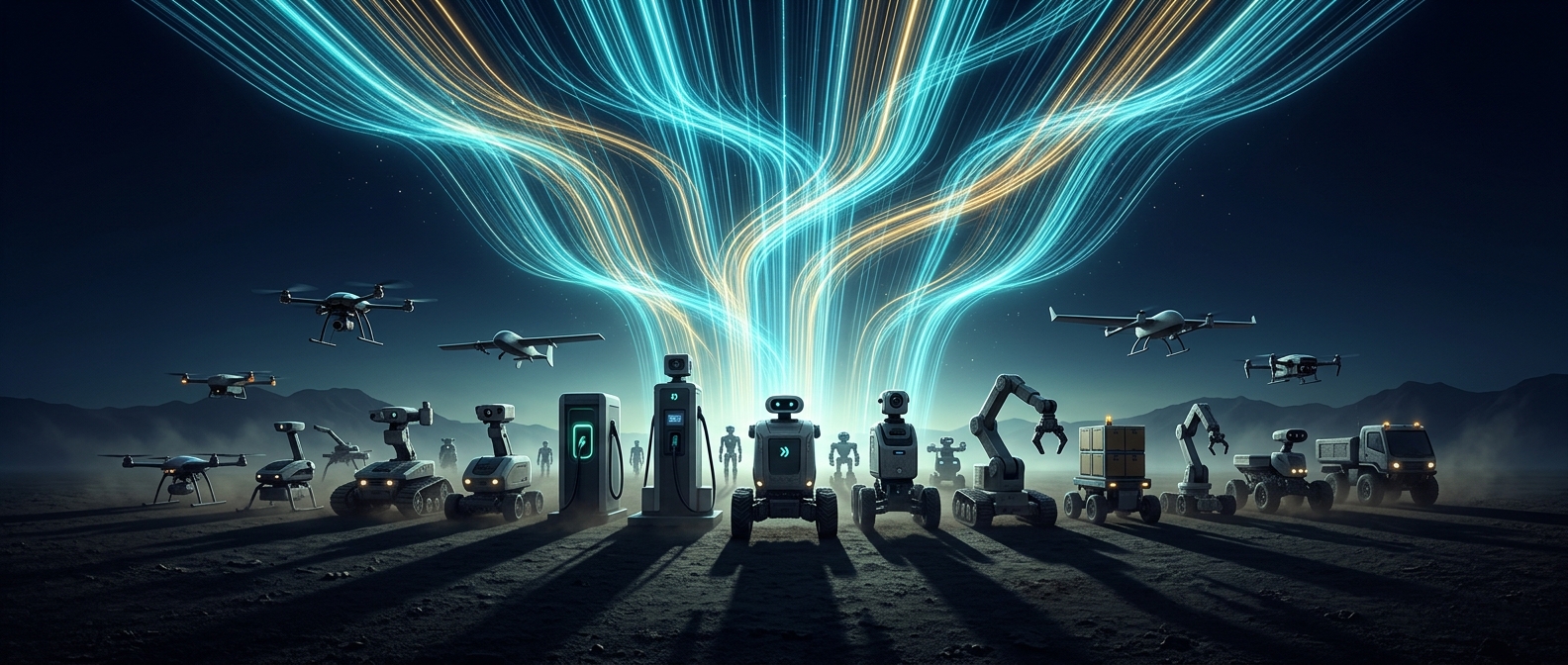
Machines deserve infrastructure that can't be captured, can't be censored, and can't be stopped.
That's why we build on Kaspa.